| Amino acids
Biosynthesis |
|||||
| |
|||||
|
|||||
| |
|||||
Nitrogen source: |
|||||
| High organisms (as animals) are unable to reduce N2 (atmospheric nitrogen) to NH3 (used in the synthesis of amino acids and other nitrogen compounds as purines and pyrimidines) - conversion called nitrogen fixation. So the animals must use their amino groups economically. When amino acids are degradated, their amino groups are transfered to 2-oxoglutarate and glutamate to form glutamate and glutamine respectively. Besides transporting these groups to the urea cycle, these amino acids can be used only to transport the amino groups, donating them latter to the synthesis of new amino acids. This shows that aminotranferases are as important in the anabolism, as they are in the catabolism. |
|||||
| Due to this limitation, the high organisms depend on a number of amino acids equal to that they need to produce, making diet sources very important. However, not all of the amino acids must be acquired by the diet, because the animal organisms are able to produce (synthetize) a great number of them, as long as they have any other amino acid to act as amino donor. When the animal does not have the necessary enzymes to synthetize an amino acid, the only source of it is the diet, this means it's essential to eat it. The amino acids are so classified as essential or nonessential. |
|||||
| |
|||||
| Carbon skeleton |
|||||
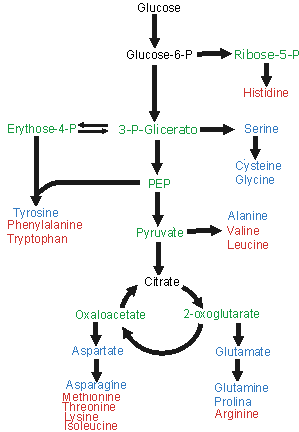
| The carbon skeletons come from intermediates of glycolysis, citrate cycle and the pentose phosphate pathway, as shown in the figure bellow. The species variations are due to wich of the amino acids each one can synthetize. In the figure, the amino acids essential to mammals are shown in red, and the nonessential in blue. The green molecules are the precursors. |
|||||
| Clique no nome de cada aminoácido para ter acesso à via de síntese de cada grupo. |
|||||
|
|
|||||
| Regulation | |||||
| |