| Basic
structure of DNA and RNA |
|
| |
|
 |
|
Nucleic
acids are polymers of nucleotides, which ones have three characteristic
components: a nitrogenous base, a pentose and a phosphate. The successive
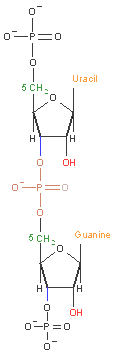
nucleotides of both DNA and RNA are covalently linked through phosphate-group
“bridges”. Specifically, the 5’-hydroxyl group of one nucleotide unit
is joined to the 3’-hydroxyl group of the next nucleotide by a phosphodiester-linkage.
|
|
DNA
and RNA both contain two major purine bases,
adenine (A) and guanine (G). DNA and RNA also contain two major pyrimidines
in both type of nucleic acid, one of these is cytosine (C). The single
important difference between the bases of DNA and those of RNA is the
nature of the second major pyrimidine: thymine (T) in DNA and uracil
(U) in RNA. |
|
Phosphodiester
linkage |
|
 |
 |
DNA |
RNA |
Note
that the green color and the blue one indicates that the strand is in
5’?3’ direction and in dark red it is seen the phosphodiester-linkage. |
|