| Sphingolipids |
| |
 |
Sphingolipids
have a polar head and two nonpolar tails, but unlike glycerophospholipids
they contain no glycerol. Sphingolipids are composed of one molecule
not the long chain amino alcohol sphingosine (4-sphingenine) or one
of its derivatives, one molecule of a long chain fatty acid, a polar
head alcohol, and sometimes phosphoric acid in diester linkage at the
polar head group. When a fatty acid is attached in amide linkage to
the –NH2, the resulting compound is a ceramide, which
is structurally similar to diacylglycerol. Ceramide is the fundamental
structural unit common to all sphingolipids |
General
Structure |
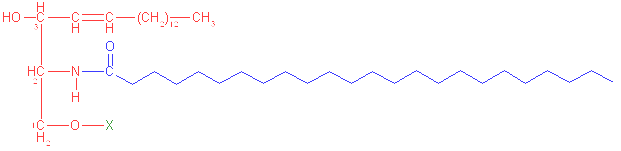 |
The
scheme above shows sphingosine in red and the fatty acid in blue. The
green X is an example of any sphingolipid take into consideration. |
There
are three subclasses of sphingolipids, all derivatives of ceramide,
but differing in their head groups: sphingomyelins, neutral (uncharged)
glycolipids, cerebrosides and gangliosides. |
|
Sphingomyelins
contain phosphocoline or phosphoethanolamine as their polar head group.
Cerebrosides have a singular sugar linked to ceramide
and gangliosides, the most complex sphingolipids, contain
a very large polar heads made up of several sugar units. Gangliosides
make up about 6% of the membrane lipids in the gray matter of the human
brain, and they are present in lesser amounts in the membranes of most
nonneural animal tissues. |