Nucleotides

The
nucleotides participate in a large amount of metabolic process and they
are considered nucleic acid subunits. They also participate as energy
carriers (ATP is an example). Nucleotide can be also found as components
enzymatic cofactors and some of them are chemical messengers.
Nucleotides
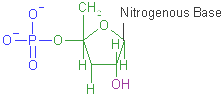
have three characteristic components: a nitrogenous base, a pentose (in
green - the hydroxyl group represented in violet color indicates that
the represented pentose is a ribose), and a phosphate group (in blue).
Without the phosphate group, the molecule is called a nucleoside.
Nucleotide
- Basic structure


Pyrimidine
Purine
The
nitrogenous bases are derivatives of two parent compounds, purine and
pyrimidine. The first one is the adenine (A) and guanine (G), and the
pyrimidine are cytosine (C), thymine (T) and uracil (U).
Note
that nucleotides have one, two or three phosphate groups covalently linked
at the 5’-hydoxyl of ribose. These are referred to as nucleoside mono-,
di-, and triphosphate, respectively. Nucleoside triphosphates are used
as a source of chemical energy to drive a wide variety of biochemical
reactions. ATP is by far the most widely used, but UTP, GTP and CTP are
used in specific reactions. Nucleoside triphosphates also serve as the
actived precursors of DNA and RNA synthesis